Surface app
A Python/Qt desktop app reads the controller over Bluetooth, sends the operator's commands as UDP packets, and shows the live camera feed for real-time monitoring.
Embedded software engineer · IoT · Web developer
I write the code that makes hardware think, talk and dive: firmware for ESP32 and Raspberry Pi, the networks that carry their commands and live video, and the web apps and ERP systems on top.
01 · Flagship hardware
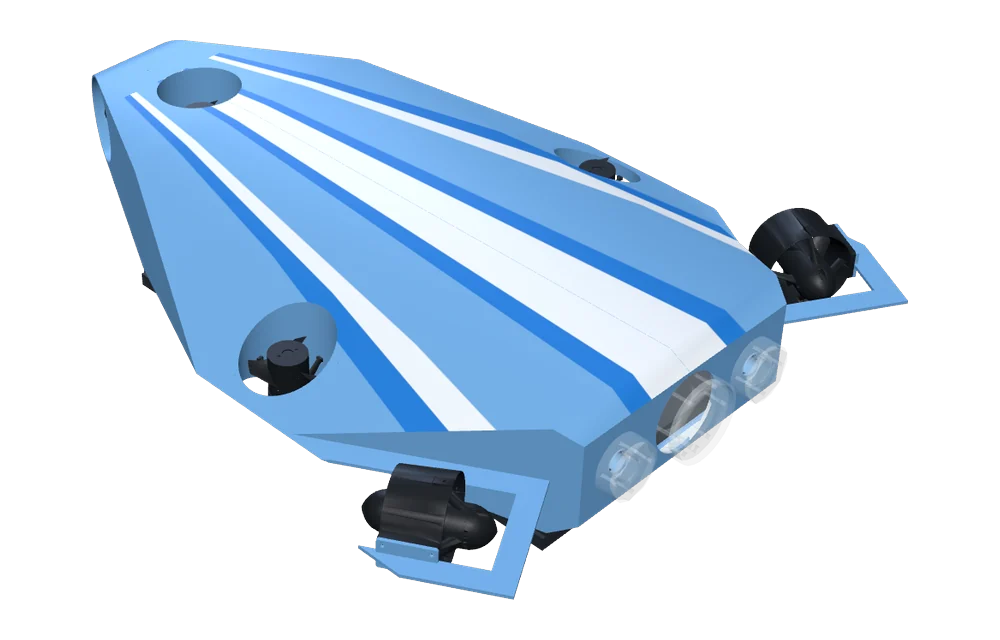
A tethered underwater vehicle, driven to 30 m. I built the control chain from a Python/Qt app on the laptop down to six PID-controlled thrusters, and the network that brings the live camera back up.
Hardware
Software
Links
Video
Control
An operator on the surface drives the ROV with a controller and watches its camera on a laptop. Under the clear acrylic covers on the front sit the IP camera and two LEDs, which switch on by themselves once it gets dark.
A Python/Qt app on the laptop reads the controller and sends each command as a UDP packet over Wi-Fi to the modem buoy, down the tether and through a switch inside the ROV to a Raspberry Pi 5. The Pi decodes it and passes PWM values to the ESP32 over serial, with PID control on the six thrusters. The camera's RTSP video rides the same IP network back up to the app.
Glowing commands going down · dashed camera video going up
A Python/Qt desktop app reads the controller over Bluetooth, sends the operator's commands as UDP packets, and shows the live camera feed for real-time monitoring.
A modem buoy at the surface, the tether, and a switch inside the ROV make one IP network. Commands go down it and the camera's video comes back up.
Receives the UDP commands, decodes them, and sends PWM values to the ESP32 over USB serial.
Turns those values into the PWM signals that drive the six thrusters, with PID control and automatic motion functions.
A sensor of our own design watches for water inside the hull. It reports to the Raspberry Pi 5, and on a leak the ROV surfaces by itself: a fail-safe that brings it home.
02 · Flagship software
A hands-on learning platform for the college students I was teaching. Docker and PostgreSQL are simulated right inside the app, so students practise real commands with nothing to install, and courses in Git, Docker, PostgreSQL and system design play out as quests.
Ship your first database
Type a command and press Enter. Type help for the list.
A learning platform that turns programming concepts into quests. I built it for the college students I was teaching, so they could practise real tools hands-on, with nothing to install.
03 · Industrial · Oil & gas
A physical well-drilling simulator for training, built for the National Iranian Drilling Company. ESP32 boards act as the rig's real control panels, and a Jetson Nano links them to the simulation software.
Try the controlsSimulation · demo only
Move a control to take over from the scroll.
A physical well-drilling simulator for training, built for the National Iranian Drilling Company. ESP32 boards act as the rig’s real control panels, so the people training on it work with panels and controls, not just a screen.
04 · Three builds
Small ESP32 builds for everyday problems. Open one for a summary.
A security camera that stays up through power cuts: a battery takes over from the mains, and a SIM uplink keeps it online when the local internet drops too.
Details + live diagram ↓A personal project: a temperature controller for sous vide cooking.
Details + live demo ↓An ESP32 infrared bridge that sends the air conditioner's remote commands, so the AC can be controlled over the network.
Details ↓A security camera built to stay up through power outages, exactly when ordinary cameras go dark: battery backup takes over from the mains, and a cellular uplink takes over from the local internet.
The diagram below shows the switch-over.
Normal operation
Running on mains power, uplinked over the local network. Toggle above to see the failover path.
A personal project: a temperature controller for sous vide cooking. It holds the water at a set temperature with closed-loop (PID) control.
The simulation below shows the idea: press Run and watch the water heat up and settle at the setpoint.
Simulation paused
Showing a representative trace of the loop settling on its setpoint. Press Run to watch it live (simulated — not live hardware).
An ESP32 infrared bridge: it sends the air conditioner’s own remote commands, so the AC can be controlled over the network.
05 · Websites & Enterprise
At Zilber in Tehran I deploy Odoo ERP for business clients, write custom Odoo modules that connect IoT devices to it, and build company websites, currently Dealfdi. I cut a dashboard's latency from 2 s to 150 ms, over 13× faster. Before that I handled client discovery and sales for a web team, so I know the client's side of the table too.
Visits this week
4,812Visits this week
4,812Same dashboard, before and after: 2 s down to 150 ms. Made-up data.
At Zilber in Tehran I deploy Odoo ERP and CRM for business clients, putting their operations in one place, and build company websites, currently Dealfdi.
Try it · a sales pipeline with made-up deals
CRM · Sales pipeline
Drag a deal to another stage, or use its arrows. Made-up deals.
What I work with
Every layer of a connected device, and where each one shows up in the work.
Leak sensor, control panels, battery backup, infrared, heaters
ESP32 and ESP32-CAM: PWM, panel I/O, closed-loop control
Raspberry Pi 5 and Jetson Nano: decoding commands, serial links to the microcontrollers
UDP control links, IP networks over a tether, RTSP camera video, a Python/Qt control app, cellular uplinks
Odoo ERP and CRM with custom modules that bring IoT data in, company websites, 3D in the browser with Three.js
Now building: Engram, a small on-device language model with a knowledge module, so new knowledge can be added right on a phone.
About
I studied Computer Engineering and ended up where hardware meets software: wiring sensors to microcontrollers, writing the firmware and services that talk to them, and getting the network right in between.
I've also sold websites and taught: Arduino to children at a robotics house, and sales and negotiation at college. Both taught me to start from what people actually need.